Buying the best commercial vacuum sealer machine is not simply about finding the most powerful model or the one with the highest price. A machine may look impressive in a product listing, but that does not mean it will fit your business.
Disclosure: As an Amazon Associate I earn from qualifying purchases. Read our Amazon Affiliate Disclosure for more information.
The better approach is to start with your own packaging work.
What do you seal every day? How many bags do you handle? Are the products dry, wet, large, small, flat, or bulky? How much space do you have? Do you need a machine for occasional preparation or repeated commercial use?
These questions matter.
A restaurant, butcher shop, catering company, meal-prep business, and food-processing operation can all need a vacuum sealer, but they may need completely different machines.
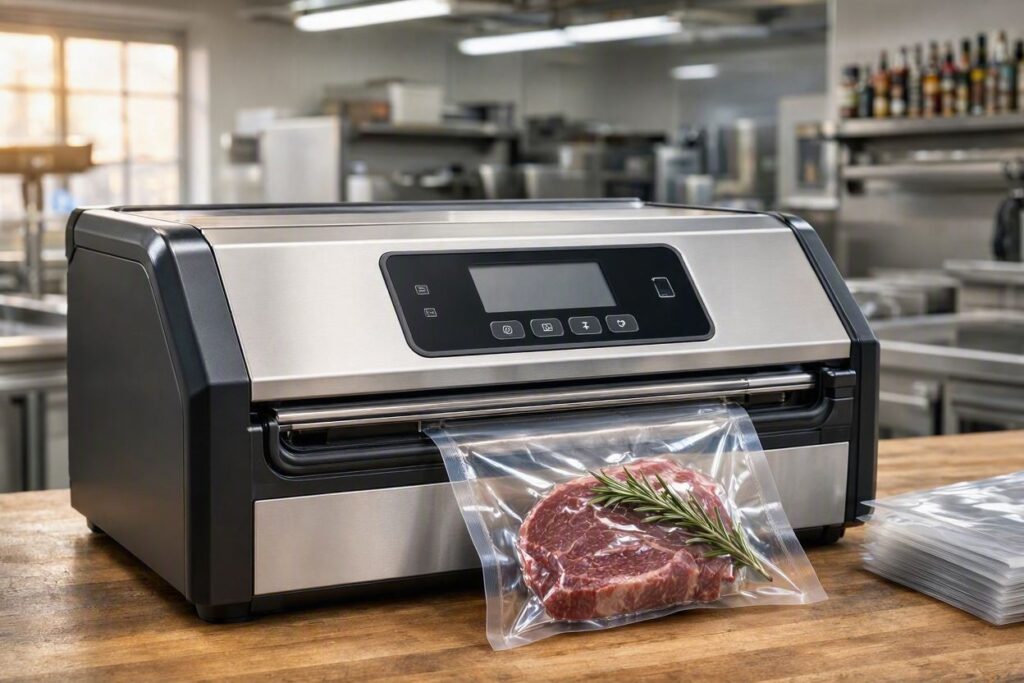
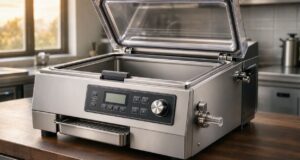
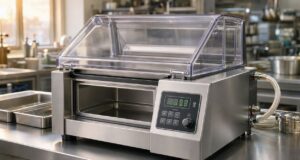
A chamber vacuum sealer can work especially well for many commercial food applications because it removes air from the chamber and bag together. This design can also make liquid and wet-food packaging easier than external suction machines.
Top Reccomendations:
TECHTONGDA DZ500
VacMaster VP321
VacMaster VP230
Here is a practical step-by-step guide to help you understand what makes a commercial vacuum sealer machine a good choice.
1. Start With Your Actual Workload
Before looking at brands or prices, calculate how many packages you normally seal.
Do you seal 20 bags a day?
Maybe 100?
Or several hundred?
Write down the average number.
Then think about your busiest day.
A machine that handles a small number of packages comfortably may struggle when you suddenly increase production. Commercial buyers should consider duty cycle and repeated operation instead of looking only at the maximum vacuum number.
If your business seals products throughout the day, cycle time becomes important.
A few seconds may not seem like much.
Multiply those seconds by hundreds of packages, though, and the difference becomes noticeable.
2. Make a List of Everything You Package
Now look at your products.
You might package:
- Beef
- Chicken
- Fish
- Cheese
- Vegetables
- Prepared meals
- Sauces
- Marinades
- Ingredients
- Dry foods
- Frozen products
Write down the largest and smallest products.
Also note which products contain liquids.
This information will help you decide what type of vacuum sealer makes sense.
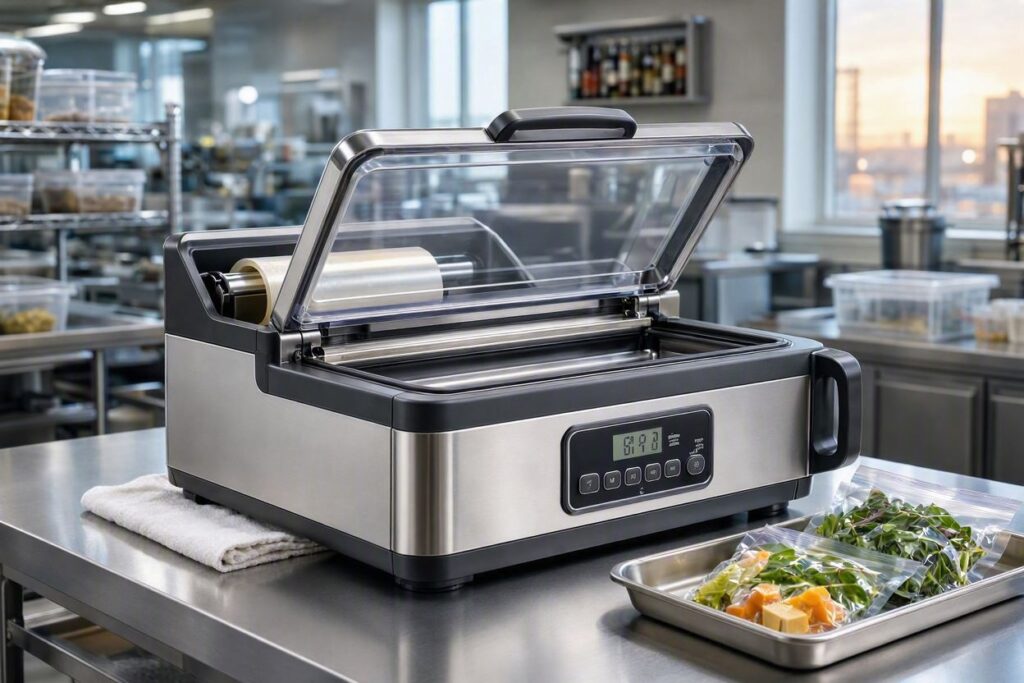
Chamber machines can be particularly useful for wet foods and liquids because the machine creates the vacuum around the entire bag rather than simply pulling air from the bag opening.
3. Decide Whether You Need a Chamber Machine
For many commercial food operations, this is an important decision.
A chamber vacuum sealer places the filled bag inside the chamber.
The machine removes air from the chamber and bag before sealing the package.
An external vacuum sealer works differently. It keeps most of the bag outside the machine and pulls air through the bag opening.
External machines can make sense for smaller workloads and dry products.
Chamber machines usually make more sense when you need regular commercial packaging, larger batches, or products containing moisture.
The right choice depends on your operation.
4. Measure Your Largest Bag
This is one of the easiest steps to skip.
Do not make that mistake.
Take the largest bag you normally use and measure it.
Then compare its width and length with the machine’s usable chamber and sealing bar.
The chamber dimensions determine whether your product and bag can physically fit inside. The seal bar limits the practical width of the bag opening you can seal. Those two measurements are related, but they are not the same thing.
A large-looking machine can still have a smaller usable chamber than you expect.
5. Check Chamber Height Too
Width and length are not enough.
You should also consider height.
This matters when you package thicker or bulky products.
It also matters when you work with certain liquid-containing products.
Measure the product at its highest point.
Then compare that measurement with the usable chamber depth listed by the manufacturer.
Do not rely on the machine’s outside dimensions.
The exterior size tells you how much floor or counter space the machine needs. It does not tell you exactly how much usable packaging space you have inside.
6. Look at the Seal Bar
The seal bar creates the final closure.
Its length affects the maximum practical bag-opening width.
If you normally use wide bags, choose a machine with an appropriate seal bar.
If you only use small pouches, you may not need an extra-wide bar.
Some larger machines also allow multiple bags to go through a cycle, depending on the design.
That can help increase production speed.
7. Pay Attention to Pump Specifications
The pump is one of the main components of a vacuum sealer.
Look at the actual specifications.
Do not rely on phrases such as “professional power” or “commercial strength.”
Check the manufacturer’s information about pump type, capacity, vacuum depth, and expected cycle performance.
Pump flow rate affects how quickly the machine can remove air, but a larger pump does not automatically make every machine faster. Chamber volume, machine design, and cycle settings also affect performance.
For a busy business, these details matter.
8. Compare Oil and Dry Pumps
You may come across both oil and dry pump systems.
Oil rotary pumps are common in heavier commercial machines. They can work well for repeated cycles but require appropriate maintenance, including oil service according to the manufacturer’s schedule.
Dry pumps generally need less maintenance because they do not use pump oil.
However, pump type alone does not tell you everything.
Look at the complete machine design, pump specifications, duty cycle, service requirements, and replacement parts.
Do not choose based on one specification.
9. Check Vacuum Control
Different products may need different vacuum settings.
A strong vacuum may work well for some firm products.
Delicate products may need more care.
A machine with adjustable vacuum controls gives you more flexibility.
Some models also allow users to save or repeat settings for different products.
That can make production easier when several employees use the same equipment.
10. Look at Sealing Controls
Vacuum is only half of the job.
The machine also needs to create a reliable seal.
Check whether you can adjust sealing time and other relevant controls.
The correct setting depends on the bag material and thickness.
Too little heat or time can create a weak seal.
Too much heat can damage the packaging.
Start with the manufacturer’s recommended settings and test your bags before running a large batch.
11. Check the Bag Compatibility
Not every vacuum bag works with every machine.
This is important.
Chamber machines commonly use smooth vacuum pouches, while external suction machines often require textured or embossed bags to allow air to move toward the vacuum channel.
Before buying a machine, confirm:
- Bag material
- Bag thickness
- Maximum bag width
- Minimum bag size
- Seal requirements
- Packaging temperature limits
Also check the cost of replacement bags.
A cheap machine can become expensive if its required bags cost significantly more over time.
12. Think About Your Workspace
Measure the area where you plan to install the machine.
Then measure the machine itself.
Do not forget working clearance.
Employees need enough space to load bags, remove finished packages, clean the equipment, and move around safely.
A large floor-standing machine may make sense for a production facility.
A countertop chamber machine may work better for a restaurant or smaller food business.
The best commercial vacuum sealer machine should fit naturally into your existing workflow.
13. Consider Electrical Requirements
Check the manufacturer’s electrical specifications before purchasing.
Confirm the voltage and power requirements for your location.
A commercial machine may need a different electrical setup from a small household sealer.
Do not assume compatibility.
Ask the supplier or manufacturer if you are unsure.
It is much easier to confirm this before purchase than to discover a problem after delivery.
14. Examine the Construction
Commercial equipment needs to handle regular use.
Look at the materials and overall construction.
Stainless-steel construction can be useful in many food environments because it offers a practical surface for routine cleaning.
But do not stop at the word “stainless.”
Look at the complete build.
Check the lid, chamber, sealing bar, controls, hinges, gasket, and other accessible components.
A machine should feel suitable for the amount of work you expect it to handle.
15. Check Cleaning Access
Food packaging creates mess.
Even when employees work carefully, small amounts of food, moisture, and grease can reach the machine.
Cleaning should not become a difficult job.
Look for a design that gives you practical access to areas that require routine cleaning.
Ask:
- Can employees clean the chamber easily?
- Can they inspect the sealing area?
- Is the gasket easy to check?
- Can food residue collect in difficult areas?
A machine that takes five minutes to clean can be much easier to manage than one that turns every cleaning session into a long task.
16. Check Replacement Parts
This point matters more than many buyers realize.
Ask the seller about replacement parts before buying.
Can you obtain:
- Gaskets?
- Seal wires or sealing components?
- Pump parts?
- Replacement lids or hinges where applicable?
- Other service components?
A machine can last for years, but components may eventually need attention.
Replacement-part availability can affect the long-term value of your purchase. Current buying guidance also recommends checking documented parts availability and warranty terms rather than relying only on marketing claims.
17. Review the Warranty
Read the warranty terms.
Do not simply look for the number of warranty years.
Find out what the warranty actually covers.
Check whether it includes:
- Pump problems
- Electrical components
- Sealing components
- Manufacturing defects
- Service support
Also find out who handles warranty repairs.
A good machine with poor support can become frustrating when something goes wrong.
18. Test the Machine Before Large-Scale Use
If possible, test the machine with your own products and bags.
This gives you useful information.
You can check:
- Vacuum quality
- Seal appearance
- Cycle time
- Bag compatibility
- Noise
- Ease of operation
- Cleaning requirements
A sample test can tell you more than a long product description.
19. Train Your Employees
Even the best machine cannot produce consistent results if employees use it differently.
Create a simple procedure.
Show employees how to:
- Prepare the product.
- Select the correct bag.
- Fill the bag.
- Keep the sealing area clean.
- Position the bag.
- Select the correct settings.
- Start the cycle.
- Inspect the seal.
- Label the package.
- Store the finished product correctly.
Keep the instructions near the machine if necessary.
Simple routines reduce mistakes.
20. Learn How to Spot a Good Seal
After each cycle, inspect the package.
Look at the seal.
A good seal should appear consistent and closed across the required area.
Watch for:
- Gaps
- Wrinkles
- Burn marks
- Weak sections
- Food trapped in the seal
- Punctures
If you find a problem, stop and identify the cause.
Do not continue sealing hundreds of packages and hope the issue disappears.
21. Keep Food Safety Separate From Vacuum Sealing
Vacuum sealing can help with packaging and storage, but it does not replace food-safety practices.
Perishable foods still need appropriate temperature control.
Follow applicable food-handling requirements.
Keep work surfaces clean.
Store products at the correct temperature.
Use proper labels and stock rotation.
Do not assume that removing air makes a perishable product safe to keep at room temperature.
That is not how vacuum packaging works.
22. Maintain the Machine Regularly
Create a maintenance schedule.
Clean the machine according to the manufacturer’s instructions.
Inspect the sealing components.
Check the gasket on chamber models.
Monitor pump maintenance requirements.
Look for unusual sounds or changes in performance.
If the machine suddenly takes much longer to reach its normal vacuum, investigate the problem.
A small maintenance task can prevent a larger production problem.
23. Avoid Choosing by Marketing Claims
This may be the most useful buying tip of all.
Do not buy a machine simply because the listing says:
“Commercial Grade.”
“Professional Power.”
“Heavy Duty.”
“Industrial Performance.”
Those phrases do not tell you enough.
Look for measurable specifications.
Check:
- Chamber dimensions
- Seal bar length
- Pump type
- Pump capacity
- Vacuum specification
- Cycle time
- Duty cycle
- Bag compatibility
- Warranty
- Replacement parts
Current buyer guidance specifically warns against treating “commercial grade” as a technical specification.
24. Think About Total Cost
The purchase price is only one part of the cost.
Also consider:
- Vacuum bags
- Electricity
- Pump maintenance
- Replacement sealing components
- Gaskets
- Repairs
- Cleaning supplies
- Employee time
A slightly more expensive machine may provide better value if it suits your workload and reduces unnecessary downtime.
On the other hand, paying extra for features you never use makes little sense.
25. Choose Based on Your Business
At this point, you should have a much clearer picture.
If you run a small kitchen and mainly package dry products, you may not need a huge machine.
If you package liquids, sauces, marinades, or wet foods regularly, a chamber machine may make more sense.
If you process large volumes, focus heavily on pump capacity, cycle time, chamber size, seal-bar length, and duty cycle.
If space is limited, measure everything before buying.
The best commercial vacuum sealer machine is the one that matches the actual work.
Common Mistakes Buyers Make
Several mistakes appear again and again.
Buying Too Small
The machine works fine at first, but larger products do not fit.
Buying Too Large
The machine takes up valuable space and costs more than necessary.
Ignoring Bag Costs
Cheap equipment can have expensive packaging requirements.
Forgetting Maintenance
The machine eventually develops problems that regular maintenance could have prevented.
Choosing by Price Alone
The cheapest machine may not offer the capacity or durability your business needs.
Believing Every Marketing Claim
Always verify specifications.
Finding the best commercial vacuum sealer machine becomes much easier when you focus on your own packaging needs instead of chasing a universal “best” model.
Start with your workload.
Measure your largest bags and products.
Decide whether you need an external machine or a chamber vacuum sealer.
Then compare chamber dimensions, sealing-bar length, pump specifications, vacuum controls, sealing controls, bag compatibility, construction, cleaning access, warranty, and replacement parts.
For high-volume work, cycle time and duty cycle deserve special attention. For wet products and liquids, chamber machines often offer practical advantages. For smaller operations, a compact machine may provide everything you actually need.
Most importantly, do not let a long list of impressive-sounding features make the decision for you.
Measure.
Compare.
Test.
Then choose.
A well-matched commercial vacuum sealer can make packaging faster, more consistent, and easier to manage. The goal is not to own the biggest machine in the room. The goal is to own a machine that can handle your daily work without unnecessary expense, wasted space, or constant maintenance problems.
Content Disclaimer: Content on Vacuum Seal HQ is provided for general informational and educational purposes only. While we aim to provide accurate and up-to-date information, errors or omissions may occur. Always check product instructions, manufacturer guidance and other appropriate sources before relying on the information provided.