Finding the best vacuum sealer for commercial use starts with one simple question: what kind of work do you need the machine to handle?
That question matters more than the brand name.
Disclosure: As an Amazon Associate I earn from qualifying purchases. Read our Amazon Affiliate Disclosure for more information.
A restaurant may need to seal meat, vegetables, sauces, and prepared meals. A butcher shop may package large quantities of meat every day. A catering business may need a machine for meal preparation and storage. A small food business may want something compact that can still handle regular orders.
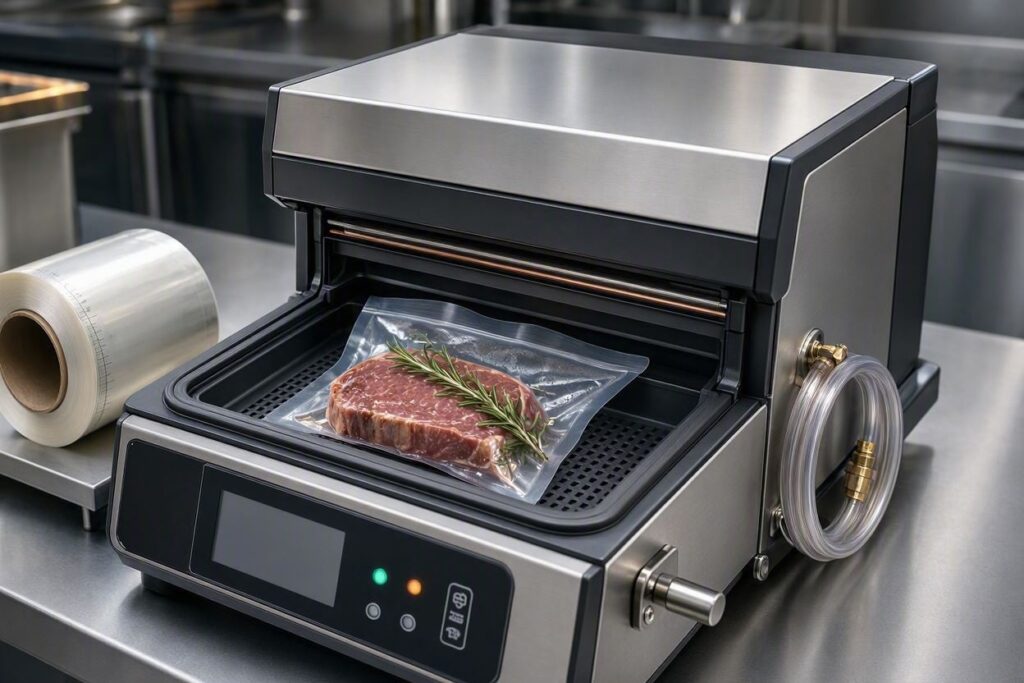
All of these businesses need vacuum sealing, but they do not necessarily need the same machine.
A good commercial vacuum sealer should fit your workload, products, bags, available space, and daily routine. It should also provide a reliable seal without making the packaging process unnecessarily slow or difficult.
This guide explains how to choose the right machine, how to set it up, how to use it correctly, and what you should check before spending your money.
1. Start With Your Daily Packaging Volume
Before comparing machines, count your packages.
How many bags do you normally seal in one day?
Do you handle 20?
50?
200?
Maybe even more?
Write down your average number and then consider your busiest days.
A machine that works well for light commercial use may not suit a business that runs hundreds of cycles every day.
Check the manufacturer’s recommended duty cycle. Also look at cycle time and pump specifications.
A faster cycle can make a real difference when employees repeat the same job throughout the day.
2. Make a Product List
Next, write down the products you plan to vacuum seal.
Your list might include:
- Beef
- Chicken
- Fish
- Cheese
- Vegetables
- Prepared meals
- Sauces
- Marinades
- Ingredients
- Dry foods
- Frozen products
Now identify which products contain moisture or liquid.
This step can influence the type of machine you should buy.
Chamber vacuum sealers work particularly well for many wet foods because they evacuate the chamber and bag together. External suction machines generally suit dry foods better and can struggle with liquids.
3. Decide Between Chamber and External Vacuum Sealers
This is one of the biggest decisions.
Chamber Vacuum Sealer
A chamber machine places the entire bag inside the chamber.
The machine removes air from the chamber and bag at the same time. It then seals the bag.
This design works well for many commercial food applications, including products containing liquids when you use the machine according to the manufacturer’s instructions.
External Vacuum Sealer
An external machine keeps the bag outside the main body.
It pulls air from the bag opening and then seals the bag.
External machines usually take up less space and can cost less. They can make sense for businesses that mainly package dry products and do not need high-volume chamber operation.
For many commercial food operations, a chamber machine offers greater flexibility.
4. Measure Your Largest Product
Do not choose a machine based on your smallest products.
Measure the biggest item you regularly package.
Then measure its bag.
For a chamber machine, compare your measurements with the usable chamber dimensions.
Check:
- Chamber length
- Chamber width
- Chamber height
- Lid clearance
- Seal-bar length
The outside dimensions of the machine do not tell you how much usable packaging space you have inside. A current chamber-sealer buying guide recommends measuring the actual pouch and food portion before choosing the chamber.
5. Check the Seal Bar Width
The sealing bar creates the final closure.
Its length determines the maximum practical opening width of the bag.
If you regularly use large bags, look for a longer seal bar.
If your products are small, a compact seal bar may work perfectly.
Do not pay extra for a huge sealing area if you never use it.
On the other hand, do not choose a small bar if your normal packaging requires wider bags.
6. Look at the Pump
The vacuum pump affects how the machine removes air.
Compare the manufacturer’s pump specifications.
Look at:
- Pump type
- Pump capacity
- Vacuum specification
- Cycle performance
- Maintenance requirements
Do not choose a machine simply because the listing uses words such as “powerful” or “professional.”
Look for measurable specifications.
For heavy commercial use, pump design and duty cycle can have a major effect on long-term performance.
7. Understand Oil and Dry Pumps
Commercial vacuum sealers can use different pump designs.
Oil-lubricated pumps can suit heavy workloads and require regular maintenance.
Dry pumps do not require pump oil and can offer a simpler maintenance routine.
Neither option automatically makes a machine the best choice.
Think about your workload.
If you run a busy packaging operation, you may prefer a machine designed for repeated cycles.
If you have a smaller workload, a lower-maintenance design may be more attractive.
Always follow the manufacturer’s maintenance instructions.
8. Check Bag Compatibility
The bag is part of the system.
You cannot choose a vacuum sealer without considering the packaging material.
Check the machine’s recommended bag type.
Some chamber vacuum sealers work with smooth chamber pouches. External suction machines commonly use textured bags that allow air to move toward the vacuum channel.
Before buying, check:
- Bag width
- Bag length
- Material
- Thickness
- Seal requirements
- Cost per bag
Also calculate your long-term bag expense.
A machine with a lower purchase price may not remain cheap if its packaging costs are high.
9. Consider the Workspace
Measure your available counter or floor space.
Then compare it with the machine’s dimensions.
Remember that you need working space around the machine too.
Employees need room to load bags, remove finished packages, clean the equipment, and move safely around the workstation.
A large floor-standing machine can make sense in a food-production facility.
A compact countertop chamber sealer may fit better in a restaurant kitchen.
10. Check Electrical Requirements
Before purchasing, confirm the machine’s electrical requirements.
Check the voltage, power requirements, and plug configuration.
Make sure the electrical supply in your workplace can support the equipment.
If you are unsure, ask the manufacturer or a qualified professional before installation.
This simple check can prevent problems later.
11. Think About Moisture
Moisture changes the packaging process.
Dry products usually create fewer problems.
Wet foods need more attention.
Sauces, marinades, soups, and juicy meats can behave differently during vacuum sealing.
This is one reason chamber machines can make sense for commercial food operations. The chamber design allows the machine to remove air from the chamber and bag together rather than pulling liquid toward an external suction port.
Always follow the manufacturer’s instructions for liquid products.
12. Prepare Your Product Before Sealing
Good preparation makes the machine’s job easier.
Start by preparing the product.
Remove unnecessary packaging.
Trim sharp edges where appropriate.
Be careful with bones, shells, or other hard objects that could puncture the bag.
Keep the product clean.
For food products, maintain proper temperature control throughout preparation and packaging.
13. Choose the Correct Bag Size
Put the product into a suitable bag.
Do not overfill it.
Leave enough empty space at the opening.
The opening should remain clean.
Avoid getting:
- Food particles
- Grease
- Oil
- Sauce
- Moisture
near the sealing area.
A clean sealing area helps the machine create a better seal.
14. Position the Bag Correctly
Follow your machine’s instructions when positioning the bag.
For a chamber machine, place the opening correctly around the sealing bar.
Keep the bag flat.
Remove large wrinkles.
Make sure the product does not interfere with the lid.
Proper positioning can prevent many common sealing problems.
15. Select the Vacuum Setting
If the machine provides adjustable vacuum controls, start with the manufacturer’s recommended settings.
Different products can require different settings.
A solid product may tolerate a stronger vacuum.
A delicate product may need more care.
Run a few test packages first.
Inspect them.
If the result looks good, record the settings for that product.
This can help employees maintain consistency.
16. Set the Sealing Time
The sealing stage deserves just as much attention as the vacuum stage.
The correct sealing time depends on the packaging material.
Too little heat or time can create a weak seal.
Too much heat can damage the bag.
Start with the manufacturer’s recommended settings.
When you change bag thickness or material, test the new setting before running a large batch.
17. Start the Cycle
Once the bag sits correctly, start the machine.
Allow it to complete the normal cycle.
If you use a chamber model, keep the lid closed during operation.
Do not reach into the chamber while the machine operates.
Watch the first few cycles when you introduce a new product or new packaging material.
18. Inspect Every Seal
Do not assume that every package came out correctly.
Check the seal.
Look for:
- Open sections
- Gaps
- Wrinkles
- Burn marks
- Weak areas
- Punctures
- Food trapped inside the seal
If you find a problem, stop and determine the cause.
Do not continue sealing hundreds of packages with the same problem.
19. Label Your Packages
Once the package passes inspection, label it according to your business procedures and applicable requirements.
Depending on your products, labels may include:
- Product name
- Packaging date
- Batch number
- Storage instructions
- Use-by information
- Other required details
Clear labeling makes inventory management easier.
It also helps employees identify products quickly.
20. Store Products Properly
Move the finished packages to the correct storage area.
Keep refrigerated products refrigerated.
Freeze products that require freezing.
Follow applicable food-safety rules.
Vacuum sealing does not make perishable food safe at room temperature.
It only changes the packaging environment.
Proper refrigeration, freezing, sanitation, and food handling remain essential.
21. Check the Machine’s Build Quality
Look at the complete machine.
Do not focus only on the stainless-steel exterior.
Inspect the:
- Chamber
- Lid
- Hinges
- Seal bar
- Controls
- Gasket
- Accessible components
The machine should match the amount of work you expect it to handle.
A busy commercial operation needs equipment designed for repeated use.
22. Make Cleaning Easy
Food equipment needs regular cleaning.
Choose a machine that does not make cleaning unnecessarily difficult.
Check whether employees can easily access the chamber, sealing area, and other parts that need routine attention.
A machine that takes a few minutes to clean can fit into a busy kitchen much better than equipment that requires a long cleaning process after every use.
23. Check Replacement Parts
Before buying, ask about replacement parts.
Find out whether the manufacturer provides components such as:
- Gaskets
- Sealing elements
- Pump parts
- Lids or hinges where applicable
- Other service components
A commercial machine may operate for years, but individual parts can eventually wear out.
Parts availability can affect the machine’s long-term value.
24. Read the Warranty
Check the warranty carefully.
Do not look only at the number of years.
Find out what the warranty covers.
Check whether it includes major components and manufacturing defects.
Also ask how warranty service works.
A good warranty can provide useful protection, especially when you depend on the machine for daily business operations.
25. Consider the Total Cost
The purchase price is not the complete cost.
Think about:
- Bags
- Electricity
- Maintenance
- Pump oil if required
- Replacement parts
- Repairs
- Cleaning supplies
- Employee time
A slightly more expensive machine may provide better value if it handles your workload efficiently.
At the same time, paying for features you never use does not make financial sense.
26. Test Before Buying When Possible
If you can test the machine, use your own products.
This is one of the best ways to judge whether a machine suits your business.
Test:
- A dry product.
- A wet product if you package wet foods.
- Your largest normal bag.
- Your normal packaging material.
- Several cycles in a row.
Check the vacuum, seal, cycle time, noise, and ease of operation.
A real test can tell you more than a product description.
27. Train Your Staff
The best vacuum sealer for commercial use still needs proper operation.
Train employees on the same basic procedure.
Show them how to:
- Prepare the product.
- Select the correct bag.
- Fill the bag.
- Keep the opening clean.
- Position the bag.
- Choose the settings.
- Start the cycle.
- Inspect the seal.
- Label the package.
- Store it correctly.
Consistency matters.
When everyone follows the same process, mistakes become easier to identify.
28. Avoid Marketing Traps
Be careful with words such as:
- Professional
- Commercial grade
- Heavy duty
- Industrial
- Premium
- High power
These terms do not tell you enough by themselves.
Instead, look at actual specifications.
Compare chamber dimensions, seal-bar length, pump type, cycle time, duty cycle, bag compatibility, warranty, and replacement parts.
A recent chamber-sealer buying guide recommends focusing on documented specifications and actual package fit rather than relying on temporary rankings or marketing claims.
29. Match the Machine to Your Business
Now bring everything together.
If you mainly package dry foods in small quantities, you may not need a large chamber machine.
If you package sauces, marinades, soups, or other wet foods, a chamber vacuum sealer may provide a better fit.
If you operate a butcher shop or food-production business with high daily volume, focus heavily on pump capacity, cycle performance, chamber size, sealing width, and duty cycle.
If you have limited space, prioritize a compact design.
There is no single machine that wins for every business.
30. Create a Simple Daily Routine
Once you choose your machine, make the workflow simple.
Prepare products before the packaging session.
Keep bags sorted by size.
Keep labels nearby.
Use standard settings for regular products.
Inspect the first packages of each batch.
Clean the sealing area frequently.
Complete routine maintenance according to the manufacturer’s schedule.
Small habits can make a big difference when employees repeat the process every day.
Common Mistakes to Avoid
Buying Too Small
The machine may look affordable, but your largest products may not fit.
Buying Too Large
A huge machine can waste money and valuable workspace.
Ignoring Bag Costs
Packaging costs can become a major part of your operating expenses.
Forgetting Maintenance
Even a strong machine needs cleaning and regular service.
Choosing by Price Alone
The cheapest machine may not provide the performance or capacity your business requires.
Believing Every Product Claim
Check the actual specifications before making a decision.
Finding the best vacuum sealer for commercial use becomes much easier when you focus on the job rather than the marketing.
Start by calculating your daily workload.
Then identify the products you package most often.
Measure your largest bags and products.
Decide whether you need an external suction machine or a chamber vacuum sealer.
After that, compare chamber dimensions, seal-bar width, pump specifications, vacuum controls, sealing controls, bag compatibility, construction, cleaning access, warranty, and replacement parts.
For businesses that package wet foods or liquids, chamber machines offer important practical advantages. For smaller operations that mainly handle dry products, an external machine may provide enough performance while taking up less space.
Do not automatically choose the most expensive machine.
Do not automatically choose the cheapest one either.
Choose the machine that matches your workload.
Test it when possible.
Train your employees.
Keep it clean.
Follow the maintenance schedule.
And always combine vacuum packaging with proper food handling, refrigeration, freezing, sanitation, labeling, and storage procedures.
The best vacuum sealer for commercial use is ultimately the one that fits your products, packaging volume, workspace, budget, and daily workflow. When those factors line up, vacuum sealing becomes much less of a chore and much more of a reliable part of your business.
Content Disclaimer: Content on Vacuum Seal HQ is provided for general informational and educational purposes only. While we aim to provide accurate and up-to-date information, errors or omissions may occur. Always check product instructions, manufacturer guidance and other appropriate sources before relying on the information provided.